
- Company
- Press Center
- Introducing Cervoz T445 & T455 M.2 2230 NVMe SSDs
NEWS
2026.04.15
Introducing Cervoz T445 & T455 M.2 2230 NVMe SSDs
SHARE
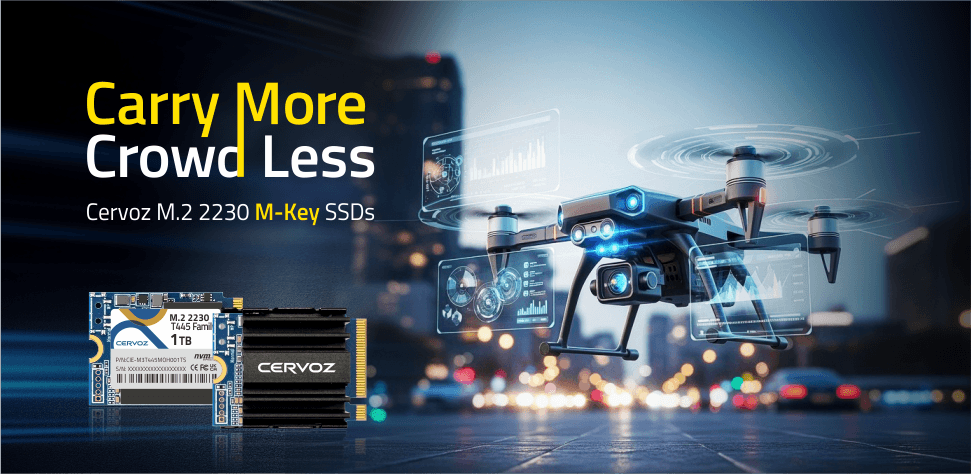
High-Speed Storage for Compact Board Designs
As AI modules and system-on-module (SoM) platforms become more widely adopted, their companion carrier boards increasingly rely on PCIe-based M.2 M-Key NVMe storage. PCIe x4 bandwidth is required for edge AI inference, machine vision, multi-camera input, and high-speed data logging.

Compared with SATA or PCIe x2 solutions, M.2 2230 M-Key NVMe storage provides higher throughput while fitting compact carrier board layouts. As a result, it has become the preferred storage interface for edge AI, embedded, and industrial systems.
Design Constraints in Compact Carrier Boards
As carrier boards become smaller and more integrated, form factor becomes as critical as performance. In some compact designs, the entire PCB may measure only around 80 × 100 mm, leaving insufficient space for standard M.2 2280 modules. Mechanical layout, enclosure height, and thermal structure often determine which form factor can be used.Designers commonly face two main constraints:
-
Space Constraints: Limited PCB space, low-profile enclosures, and thermal structures often prevent the use of full-length M.2 2280 modules or standard heatsinks.
-
Performance Requirements: Robotics, UAV, compact IPC, and other embedded platforms still require PCIe x4 NVMe bandwidth even when only short modules can fit.
These constraints are increasingly common in compact carrier board and embedded system designs, where M.2 2230 often becomes the only practical storage form factor.
Gen4 NVMe Performance in the 2230 Form Factor
When only a short SSD can fit, the interface becomes as important as the form factor. M.2 B-Key and B+M-Key modules are typically limited to SATA or PCIe x2, while M.2 M-Key supports PCIe Gen4 x4 NVMe within the same 2230 footprint.For compact carrier boards, M.2 2230 M-Key enables the same PCIe Gen4 x4 NVMe architecture used in larger 2280 SSDs, but in a much smaller footprint. The Cervoz T445 and T455 series combine the M.2 2230 form factor with PCIe Gen4 x4 M-Key performance, delivering high-speed storage in layouts where standard 2280 modules cannot be used.
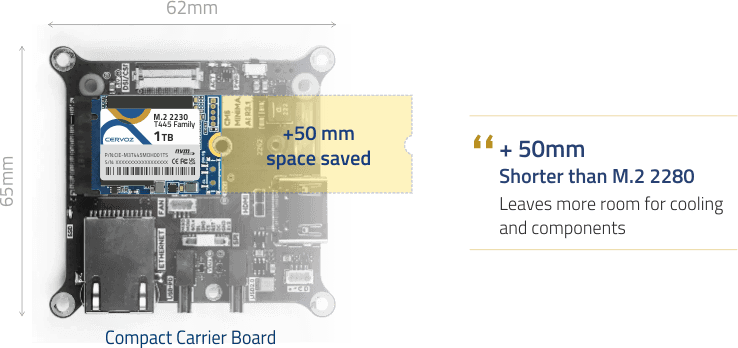
Key advantages of the T445 / T455 series include:
-
M.2 2230 M-Key: For compact carrier boards and low-profile systems.
-
PCIe Gen4 NVMe: For AI, vision, and high-throughput workloads.
-
Thermal Compatibility: Wide-temperature support with optional micro-heatsink.
-
Flexible Reliability: Performance-focused or endurance-focused options, with optional Write Protect and MIL-STD-810H.
Performance or Endurance, Built for Your System
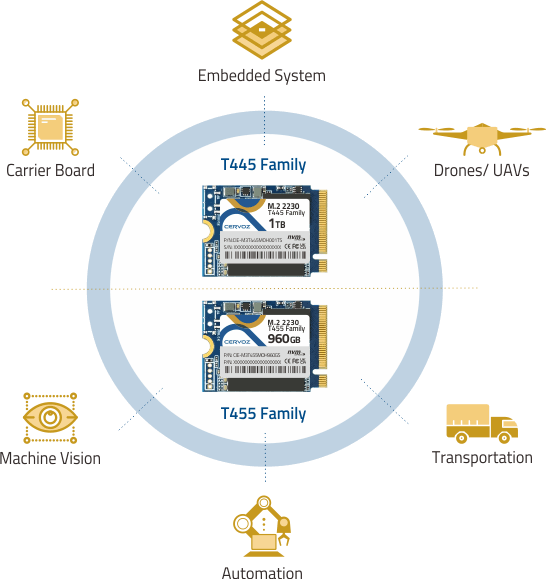
The T445 is designed for high-speed operation with a DRAM-less architecture and optimized firmware, providing strong performance with low power consumption. It is ideal for Jetson-based carrier boards, compact IPCs, and UAV systems that require maximum performance in a limited footprint.The T455 shares the same M.2 2230 footprint but is optimized for heavier workloads. With over-provisioning technology, enhanced firmware protection, and Safeguard/Circuitguard, it provides higher endurance and long-term stability for machine vision, transportation, data logging, and industrial automation applications.
Built for Space-Constrained System Designs
As embedded platforms continue to shrink, storage selection is increasingly defined by both available space and required bandwidth. In many designs, M.2 2230 M-Key is no longer an alternative to 2280. It is the form factor required to meet both mechanical and performance requirements.The Cervoz T445 and T455 series are designed to carry more performance, bandwidth, and reliability within a smaller footprint. From carrier boards and compact IPCs to robotics, machine vision, and edge AI systems, they make it possible to carry more, while crowding less. Contact us for more information.
Cervoz M.2 NVMe SSDs
| Family | T425 | T421 | T405 | T436 | ||
| Form Factor | M.2 2230 | M.2 2242 | M.2 2242 | M.2 2242 I 2280 | M.2 2280 | |
| Interface | Gen 3x2 | Gen 3x4 | ||||
| Connector | A+E | B+M | B+M | M | ||
| Capacity | 128GB/ 256GB |
128GB ~512GB |
120GB ~1920GB |
128GB ~1TB |
240GB ~1920GB |
|
| Special Feature | – | – | – | – | – | Powerguard |
| Performance Seq. Read/ Write(MB/s) |
Up to 880/820 |
Up to 1,300/1,050 |
Up to 1,770/1,520 |
Up to 1,780/1,640 |
Up to 2,605/1,880 |
Up to 3,445/1,000 |
| Operating Temp. | 0°C~70°C/-40°C~85°C | 0°C~70°C/-40°C~85°C | ||||
| Family | T441 | T445 I T455  |
T445 I T455 | |||
| Form Factor | M.2 2280 | M.2 2230 | M.2 2242 I 2280 | |||
| Interface | Gen 4x4 | |||||
| Connector | M | |||||
| Capacity | 480GB ~3840GB |
256GB ~1TB |
240GB ~960GB |
256GB ~2TB |
240GB ~1960GB |
|
| Special Feature | w/DRAM buffer | – | – | – | – | |
| Performance Seq. Read/ Write(MB/s) |
Up to 7,100/6,190 |
Up to 5,095/4,740 |
Up to 5,080/4,740 |
|||
| Operating Temp. | 0°C ~ 70°C | 0°C~70°C/-40°C~85°C | 0°C~70°C/-40°C~85°C | |||
