
- Company
- Press Center
- Embedded Computers Explained: Types, Features, Uses, and More
BLOG
2026.04.29
Embedded Computers Explained: Types, Features, Uses, and More
SHARE
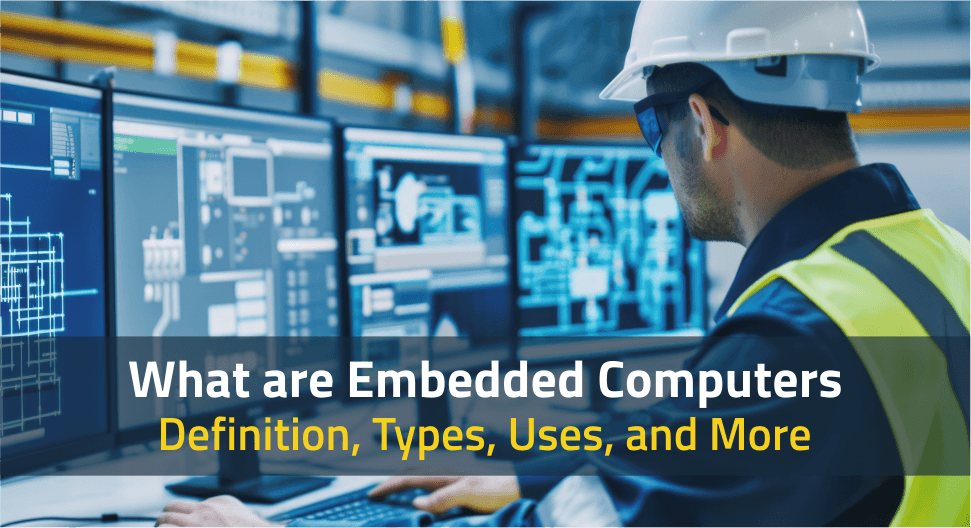
Modern machines and smart devices rely on hidden computing power, yet many people still lack a clear definition of embedded computer systems and how they work. This can make it difficult to understand why they are essential in today's technology. In this guide, we break down the basics of embedded computing, explain the core concept, and explore practical examples of embedded computers used in industries and automated systems. Let's dive in!
What are Embedded Computers?
Embedded computers are specialized computing devices designed to perform dedicated functions, typically for specific applications or systems. Unlike general-purpose PCs, they are built to execute a specific set of tasks reliably and continuously. These compact computing units typically include a processor, memory, and input/output (I/O) interfaces that allow them to communicate with sensors, machines, and other devices. We will look at the core components later.Embedded computers are a core element of embedded computing, where computing power is integrated directly into machines and devices to enable intelligent control, monitoring, and automation. Rather than functioning independently, these computers are usually part of a broader embedded system designed to perform a specific task within a larger mechanical or electronic device.
A typical embedded system usually includes three main elements:
-
Hardware: Processors or microcontrollers, memory modules, and supporting circuitry that perform computation and data storage.
-
Software or Firmware: System-level programs and application code stored in flash or read-only memory that control how the hardware operates.
-
Peripherals and Interfaces: Communication ports and I/O connections such as GPIO, USB, Ethernet, CAN Bus, or serial interfaces that link the system with sensors, actuators, and external equipment.
In practice, embedded computers are often integrated directly into machines, although some are deployed as standalone industrial systems. They serve as the intelligence behind systems such as automated production equipment, transportation control systems, and smart industrial devices.
Embedded Computers vs General-Purpose PCs
At first glance, embedded computers and general-purpose PCs may look similar. Both use processors, memory, and circuit boards to perform computing tasks. However, their design goals and operating environments are very different.A general-purpose PC is built to handle a wide variety of tasks. Users can install different software applications, browse the web, edit documents, or run complex programs. These systems focus on flexibility and user interaction, which is why they include keyboards, monitors, and operating systems designed for everyday use.
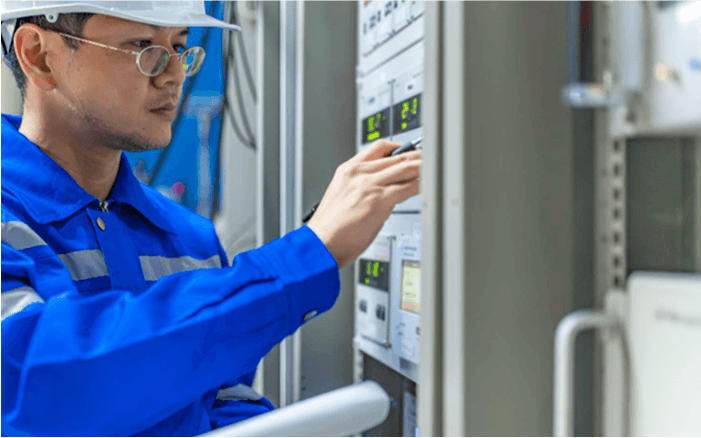
Embedded computers, on the other hand, are designed for a specific purpose inside a larger device or machine, mostly for industrial scenarios. Instead of running many applications, they focus on executing predefined tasks reliably and efficiently. Many of them operate continuously and autonomously for years and must withstand demanding environments such as factories, transportation systems, or outdoor installations.
| Feature | Embedded Computer | General-Purpose PC (Desktop or Laptop) |
| Purpose | Performs dedicated functions for specific systems or applications | Runs multiple applications for general use |
| Design | Compact, rugged, often fanless for industrial environments | Larger ventilated systems designed for offices or homes |
| Power Consumption | Low power, optimized for continuous operation | Higher power usage to support high performance |
| User Interaction | Usually autonomous with minimal user input | Requires direct human interaction |
| Real-Time Capability | Often supports real-time processing for control systems | Not designed for strict real-time operation |
Key Components of Embedded Computers
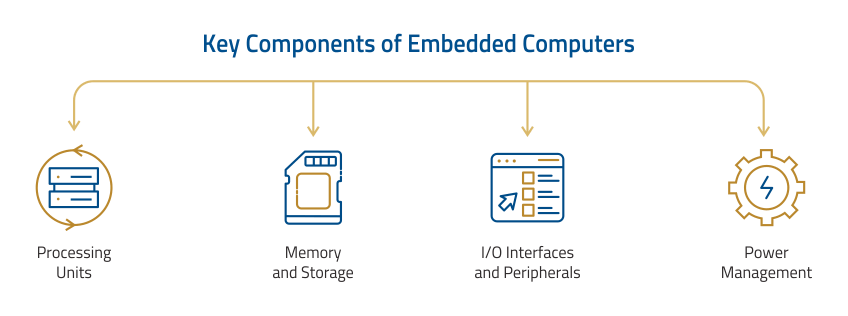
Unlike general-purpose PCs, every component in an embedded computer is carefully selected to support stable and long-term operation. These systems are typically built around several key elements, like memory, storage, and I/O interface, that work together to process data, communicate with devices, and manage system performance.
Processing Units
The processor acts as the main computing engine of an embedded computer. Depending on the complexity of the application, different types of processing units may be used.In embedded computers, microprocessors (MPUs) are commonly used as the primary processing units, especially in systems that require higher performance and operating system support. These processors rely on external memory and supporting components, making them suitable for more complex workloads.
Microcontrollers (MCUs) are also used in some compact embedded computer designs, as they integrate the CPU, memory, and input/output interfaces into a single chip, making them compact and cost-efficient for simpler control tasks.
Modern embedded computers may also include specialized accelerators. Examples include GPUs for graphical workloads, DSPs for signal processing, and AI-focused processors such as NPUs for machine learning and edge analytics. Many embedded computer platforms today adopt a System-on-Chip (SoC) design, which integrates multiple processing units, memory controllers, and communication interfaces into a single compact chip.
Memory and Storage
Memory and storage are essential components that enable an embedded computer to run applications, store data, and maintain stable operation. Memory enables an embedded computer to store both instructions and operational data. There are two different types of memory with different purposes:- Non-volatile memory, such as flash or ROM, stores the system’s firmware, which contains the essential instructions required for the device to operate. Because this memory retains data even when power is removed, it ensures the system can start and run reliably.
- Volatile memory, such as DRAM or SRAM, is used during operation to temporarily store data and execute programs. This runtime memory allows the embedded computer to process information quickly while performing its assigned tasks.
Storage becomes important in more advanced embedded computers that handle larger datasets or complex applications. Many industrial platforms use solid-state drives (SSDs), including 2.5-inch or M.2 form factors, which offer higher reliability due to the absence of moving parts. This makes them more resistant to shock and vibration in harsh environments.
Compact embedded computers may also support space-efficient designs to maintain a small footprint. For security-sensitive applications, storage solutions can include self-encrypting drives (SEDs) that protect data from unauthorized access.
I/O Interfaces and Peripherals
Embedded computers interact with the external environment through a range of input and output interfaces. These connections allow embedded computers to collect data from sensors, communicate with other devices, and control mechanical components.For example, GPIO (General Purpose Input/Output) ports enable the embedded computers to receive digital signals from sensors or send commands to actuators such as motors, lights, or relays. Communication protocols like I2C and SPI allow internal components to exchange data efficiently, while USB, Ethernet, and CAN bus connections support device communication and industrial networking.
Some embedded computer platforms support integration with analog-to-digital (ADC) and digital-to-analog (DAC) converters, either onboard or through external modules. These components allow the computer to process analog signals from the physical world, such as temperature, pressure, or voltage measurements.
Power Management
Efficient power management is vital for embedded computers, especially in systems that operate continuously or rely on battery power. Embedded platforms often include dedicated power regulation circuits that control voltage levels and protect components from instability. To reduce energy consumption, many systems implement techniques such as dynamic voltage scaling and low-power sleep modes, allowing the device to conserve energy when it is idle.Features of Embedded Computers
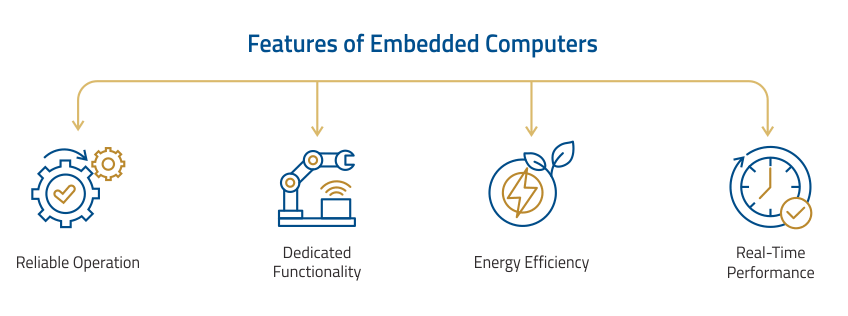
Embedded computers provide several advantages that make them well-suited for industrial equipment, smart devices, and specialized control systems. Because they are designed for dedicated tasks rather than general computing, these systems can deliver high efficiency, reliability, and long operational lifespans in environments where traditional PCs may struggle.
Reliable Operation
Embedded computers are often deployed in challenging environments. To meet these demands, many are designed as rugged embedded computers capable of handling temperature fluctuations, vibration, and long-term operation without performance degradation.Their reliability is strengthened by fanless cooling architectures, where heatsinks and the system chassis dissipate heat instead of mechanical fans. By removing moving parts, these systems reduce potential failure points while maintaining stable thermal performance. The sealed design also helps prevent dust from entering the system, minimizing component wear.
In addition, many embedded computers rely on solid-state components, which further reduce the risk of mechanical failure. Together, these design factors allow embedded systems to operate 24/7 with minimal human intervention, making them well-suited for applications that require dependable operation.
Dedicated Functionality
One of the biggest advantages of embedded computers is their task-focused design. Since they are built to perform specific functions, engineers can optimize the hardware and software for maximum efficiency, stability, and cost-effectiveness.This targeted design also allows for a smaller form factor, which is critical for space-constrained applications. In engineering terms, many embedded systems are designed to meet SWaP-C requirements: Size, Weight, Power, and Cost. This makes them suitable for applications such as UAVs, AGVs, AMRs, medical equipment, industrial sensors, and wearable technologies.
Energy Efficiency
Embedded computers are typically designed with low power consumption. Many systems operate continuously for long periods, so reducing energy use helps lower heat generation, improve reliability, and reduce operational costs.Advanced power management techniques allow systems to reduce energy consumption during idle time through sleep modes or dynamic voltage adjustments. In some applications, embedded devices can even support energy harvesting technologies, drawing power from sources such as solar energy, heat, or radio signals.
Real-Time Performance
For applications such as industrial automation, transportation systems, or defense technologies, real-time processing is essential. Embedded computers can be designed to respond to inputs and deliver outputs within strict timing requirements, ensuring that machines and control systems operate safely and efficiently.Common Types of Embedded Computers
Embedded computers come in different forms depending on application needs, performance requirements, and deployment environments. Understanding these common types helps manufacturers, system integrators, and end users select the most suitable platform for their specific use case.Single Board Computers (SBC)
SBCs are compact, ready-made computer boards that integrate the processor, memory, and I/O interfaces onto a single circuit board. They are widely used in both industrial applications and rapid prototyping, with well-known examples including Raspberry Pi. Available in standardized form factors such as 3.5", Pico-ITX, and ultra-compact boards, SBCs offer a strong balance between performance, flexibility, and space efficiency.Industrial PCs (IPC)
Industrial PCs are designed to act as the central control hub in systems where reliability and performance are critical. Built for long-term deployment, they can operate in harsh environments with exposure to temperature changes, vibration, and continuous workloads. IPCs often use larger motherboard formats such as ATX, Micro-ATX, or Mini-ITX, allowing for greater expansion through multiple PCIe slots and supporting complex industrial applications.Fanless Embedded BOX PC
Fanless Box PCs use passive cooling designs, relying on heatsinks and the system chassis to dissipate heat without mechanical fans. This improves system reliability by removing common points of failure and preventing dust buildup in harsh environments. These systems are also silent and low-maintenance, making them ideal for applications such as IoT gateways, edge computing, and remote industrial monitoring.Panel PCs
Panel PCs combine a display and computing system into a single unit, functioning as Human-Machine Interfaces (HMIs) for interactive control. They are commonly used in industrial automation, transportation systems, and retail environments. Specialized versions are available for different industries, including IP-rated models for washdown environments, medical-grade systems, and rugged designs for high-vibration applications.Other Types
Another common way to classify embedded computers is based on how they operate and interact with their environment.-
Real-Time Embedded Systems: As we've discussed, real-time embedded systems must respond to inputs and generate outputs within a defined time limit. In hard real-time systems, missing a deadline can cause system failure, which is critical in applications such as aircraft control or defense systems. Soft real-time systems, on the other hand, can tolerate minor delays but may experience reduced performance, such as in environmental monitoring or data collection systems.
-
Standalone Embedded Systems: Standalone systems operate independently without requiring a host computer. They are designed to perform specific tasks on their own, often as part of consumer electronics or industrial equipment. Examples include digital cameras, calculators, and household appliances.
- Networked Embedded Systems: Networked embedded computers communicate with other devices or servers through wired or wireless connections. These systems are commonly used in applications such as point-of-sale (POS) terminals, industrial monitoring systems, security systems, and automated banking machines (ATMs).
- Mobile Embedded Systems: Mobile embedded systems are compact and portable devices designed for mobility and battery operation. Examples include smartphones, fitness trackers, handheld scanners, and other portable electronics that require embedded processing.
Applications of Embedded Computer Systems
Embedded computers act as the intelligence behind countless modern technologies. These systems are widely deployed across industries ranging from smart cities to healthcare and industrial automation. Here are some of the most common areas and examples where embedded computing plays a critical role.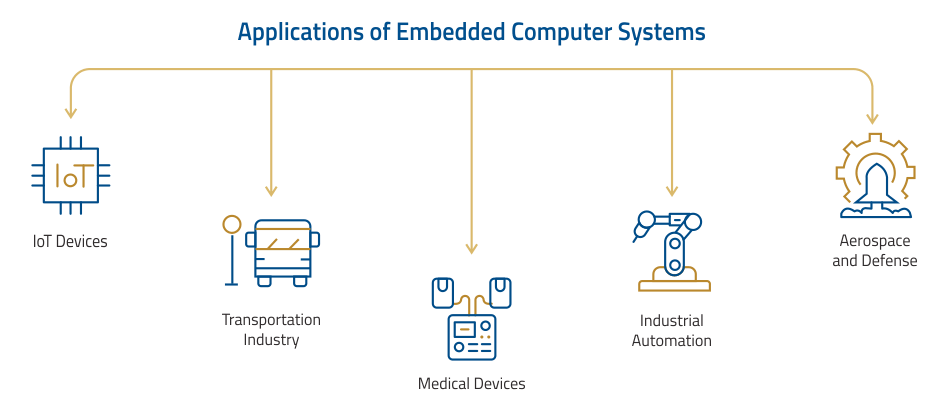
IoT Devices
Embedded computers form the backbone of the Internet of Things (IoT) because they can continuously collect, process, and transmit data while maintaining low power consumption and compact size. This makes them ideal for large-scale deployment in smart meters, environmental sensors, and agricultural monitoring systems.Many modern devices also integrate edge AI, enabling local data analysis for anomaly detection and predictive maintenance, which reduces latency and bandwidth usage. In addition, embedded systems support smart city infrastructure such as traffic signal control, intelligent parking, and connected surveillance networks, improving urban efficiency and safety.
Transportation Industry
The transportation industry relies on embedded computers due to their ability to deliver real-time control, reliability, and safety in dynamic environments. These systems manage essential vehicle functions, including anti-lock braking systems (ABS), electronic stability control (ESC), traction control, and airbag deployment.Because embedded platforms can process data instantly and operate under harsh conditions, they are also critical for Advanced Driver Assistance Systems (ADAS) and autonomous driving technologies, where fast and accurate decision-making is required.
Medical Devices
Embedded computers are widely used in medical devices because they provide high precision, stability, and real-time data processing. Patient monitoring devices such as heart rate monitors, infusion pumps, and wearable sensors depend on embedded systems to ensure accurate and continuous health tracking.More advanced equipment like MRI, CT, and PET scanners also relies on embedded computing to control imaging processes and system operations. In modern healthcare environments, embedded-powered medical gateways collect and analyze data from multiple bedside devices, enabling more efficient patient monitoring and clinical decision-making.
Industrial Automation
In industrial automation and manufacturing, embedded computers are essential for achieving precision, efficiency, and continuous operation. They are used to control machinery, monitor production lines, and optimize workflows in advanced manufacturing environments.For example, Programmable Logic Controllers (PLCs) use embedded processors to automate assembly lines and manage sensor inputs. Industrial robots depend on embedded controllers for precise, real-time movements in tasks such as welding, assembly, and packaging. Also, embedded sensors enable predictive maintenance by continuously monitoring conditions like vibration and temperature, helping prevent unexpected downtime.
Aerospace and Defense
Embedded computers are critical in aerospace and defense applications because they offer real-time performance, high reliability, and fault tolerance in extreme environments. They are used to control avionics systems, navigation equipment, and flight control mechanisms in aircraft and spacecraft.Embedded computers also power guidance and communication systems in unmanned aerial vehicles (UAVs), satellites, and defense technologies. Historically, one of the earliest examples is the Apollo Guidance Computer, developed in the 1960s to manage navigation and onboard operations during NASA’s lunar missions, demonstrating the importance of compact, reliable computing in mission-critical scenarios.
How to Choose the Right Embedded Computer
Processing Power and Architecture
The processor architecture determines how well the embedded computer can handle its intended workload. Choosing the right architecture helps balance performance, power consumption, and system cost.-
ARM: Ideal for low-power, cost-efficient systems such as IoT devices and edge computing platforms.
-
x86: Better suited for high-performance computing, graphics processing, and applications that require compatibility with legacy x86 software.
Operating Environment
Embedded computers are often deployed in challenging environments where reliability and durability are essential.-
Many industrial systems adopt fanless designs, which reduce dust accumulation and eliminate cooling fans that could fail over time.
-
Systems may also need to support shock and vibration resistance, especially in transportation or manufacturing environments.
-
In addition, industrial embedded computers are typically designed to operate across extended temperature ranges, commonly from −20°C to 60°C or higher.
Connectivity Requirements
Connectivity plays a key role in how embedded computers interact with other devices and systems. Most platforms provide standard interfaces such as LAN, USB, serial ports, CAN bus, and display outputs like HDMI or DisplayPort.Some applications also require GPIO connections for direct control of sensors, actuators, or industrial equipment. In modern connected systems, wireless technologies such as 5G, Wi-Fi, NB-IoT, or LoRaWAN are increasingly used to enable remote monitoring, data transmission, and IoT deployments.
Scalability and Lifecycle
Industrial deployments often require systems that remain available and supported for many years. Many embedded platforms offer long product lifecycles of 5 to 15 years, helping manufacturers maintain a stable supply and avoid frequent redesigns.Scalability is also important when system requirements evolve. Expansion interfaces such as PCIe, M.2, or mPCIe slots allow developers to add modules for networking, storage, or specialized functions without replacing the entire system.
Software Requirements
Some embedded applications must process data within strict time limits to ensure safe and predictable system behavior. In these cases, the platform should support real-time operating systems (RTOS) capable of delivering consistent response times.It is also important to verify that the hardware is compatible with the required development tools and programming environments, including commonly used languages such as C and C++, which are widely used in embedded software development.
Security and Reliability
Security and long-term stability are increasingly important for connected systems. Modern embedded platforms often include secure boot and hardware root-of-trust to protect system integrity. Support for secure over-the-air (OTA) updates helps maintain devices over time, while a high Mean Time Between Failures (MTBF) indicates strong reliability for continuous operation.Cervoz Powers Industrial Systems with Durable Embedded Computer Storage Solutions
Embedded computers rely on stable, high-performance memory to maintain consistent operation in industrial environments. From factory automation to transportation systems, reliable storage and memory components ensure that embedded platforms can process data efficiently and run continuously without interruption.Cervoz specializes in delivering comprehensive industrial solutions built around three core components: Storage, Memory, and Connectivity. Our portfolio includes Industrial SSDs, DRAM modules, and Expansion Cards, all designed to work together seamlessly in embedded computers and industrial systems.
These three elements are essential for ensuring system stability in demanding environments, enabling reliable data storage, highly efficient processing, and flexible system expansion. Built for durability, long-term availability, and consistent performance, Cervoz solutions support a wide range of applications, including industrial automation, transportation, and edge computing.
Contact us now for more details or explore Cervoz's all-in-one industrial storage and expansion solutions to power your next embedded system.
