
- Company
- Press Center
- What is a Differential Signaling: How It Works, Examples & More
BLOG
2026.07.31
What is a Differential Signaling: How It Works, Examples & More
SHARE
High-speed devices rely on fast, stable data transfer, but as signal speeds increase, even small noise, voltage shifts, or layout issues can cause communication errors. For those who are new to hardware design, differential signaling may sound complex, yet it is one of the core methods behind modern interfaces. In this article, we will explain everything you need to know about differential signaling basics, including how it works, how it compares with single-ended signaling, why it improves reliability, and where it appears in real-world systems.
What is a Differential Signal?
A differential signal is a way of sending electrical data through two wires instead of one. In high-speed communication, these two conductors are known as differential pair signals. They are often described as the A-wire and B-wire, and they carry the same data in opposite electrical directions.In simple terms, when one wire carries a positive voltage, the other carries an equal negative voltage at the same time. These two signals have the same strength but opposite phase. Instead of checking one signal against ground, the receiver reads the voltage difference between the two wires.
This makes differential signaling especially useful in high-speed systems, where stable data transfer is important. By comparing two complementary signals, the receiver can identify binary data more accurately, even when the circuit is exposed to electrical noise or small voltage disturbances.
Single-Ended vs Differential Signals
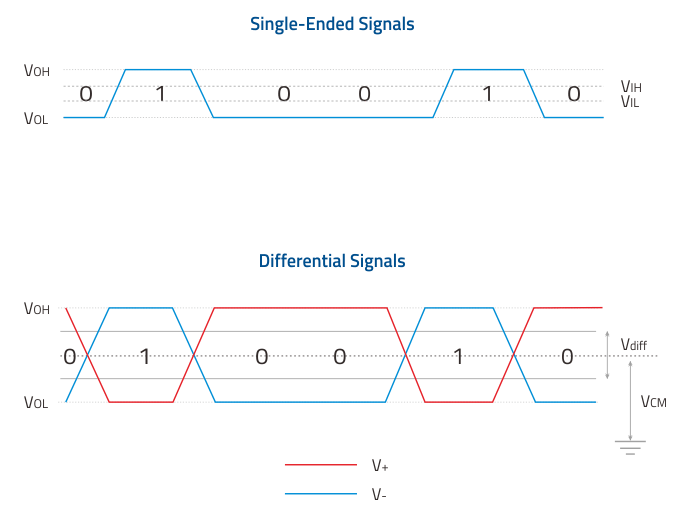
To better understand why differential signaling is widely used in modern high-speed applications, we must compare it with single-ended signaling. Both methods transmit electrical data from a transmitter to a receiver, but they differ in how the signal is referenced, how much noise they can tolerate, and how well they perform at higher speeds.
In single-ended signaling, data is sent through one signal wire, and the voltage is measured against a shared ground reference. This method is simple and uses fewer traces on a circuit board, but it is more sensitive to noise. If electrical interference affects the signal wire or if the ground level shifts, the receiver may misread the data.
In differential signaling, the receiver does not depend on a single wire or an absolute ground voltage. Instead, it compares the voltage between two opposite-polarity wires. Since the pair is routed close together, outside noise usually affects both wires in a similar way. The receiver subtracts one signal from the other, which helps reject shared noise and preserve the original data.
| Feature | Single-Ended Signaling | Differential Signaling |
|---|---|---|
| Wiring | Uses one signal wire with a return path or ground | Uses two signal wires as a matched pair |
| Signal Reference | Measured against a common ground | Measured by comparing the two wires |
| Noise Immunity | More sensitive to EMI and ground noise | Stronger noise rejection through common-mode cancellation |
| Ground Dependence | Highly affected by ground shifts | Less affected by ground potential differences |
| Voltage Requirement | Often needs higher voltage swings for clear detection | Can work with lower voltage swings and enable higher power efficiency |
| High-speed Performance | More limited at higher frequencies | Better suited for fast data transfer |
| EMI Emissions | More likely to radiate noise | Lower EMI due to opposing signal fields |
| PCB Layout Space | Uses fewer traces | Requires two matched traces per signal |
How Does Differential Signaling Work?
Differential signaling works by sending information as the voltage difference between two matched conductors. In a differential pair circuit, the receiver compares the two signal lines and determines the data value from their relationship.For example, if the A-wire is at a higher voltage than the B-wire, the receiver may read it as logic high, or 1. If the B-wire is higher than the A-wire, the receiver reads it as logic low, or 0. The key point is that the receiver focuses on the line-to-line voltage difference, not the absolute voltage of each line compared with ground.
This design also helps reduce errors caused by ground offsets. In real systems, the ground level at the transmitter and receiver may not be exactly the same. Since the receiver reads the difference between the two wires, small shifts in ground voltage are less likely to affect the final logic decision.
Noise rejection is another major part of how differential signaling works. When the two wires are placed close together through proper differential pair routing, external interference usually affects both lines in a similar way. Because the receiver subtracts one signal from the other, this shared noise is largely canceled out. This process is known as common-mode rejection.
Two common technologies used in high-speed differential signaling are LVDS and CML.
- LVDS, or Low-Voltage Differential Signaling, is widely used for high-speed data transmission with low power consumption. It uses a small voltage swing, which allows signals to switch quickly while producing less electrical noise. Because of this, LVDS is often found in display interfaces, embedded systems, and other applications that require stable data transfer over copper traces or cables.
- CML, or Current Mode Logic, is another differential signaling technology designed for very high-speed serial communication. It is commonly used in interfaces where signal quality must be maintained at high data rates, such as PCIe, SATA, SAS, retimers, and redrivers. Compared with LVDS, CML is often associated with faster serial links and high-performance signal-conditioning circuits.
Advantages of Differential Signaling
Differential signaling is widely used in high-speed communication because it helps improve signal integrity (SI), by keeping signals cleaner, more stable, and easier to interpret. Its advantages come from the way the two signal lines work together as a balanced pair, allowing the system to reduce noise, EMI, crosstalk, timing errors, and ground-related disturbances.Better Noise Resistance
One of the biggest advantages of differential signaling is its strong resistance to external noise. When electromagnetic interference reaches the pair, it usually affects both wires in nearly the same way because they are routed close together. This shared interference is known as common-mode noise.The ability of a differential receiver to reject this type of shared noise is often described by Common-Mode Rejection Ratio, or CMRR. A higher CMRR means the receiver is better at ignoring noise that appears on both lines while preserving the intended voltage difference. This allows the original signal to remain clearer, even in electrically noisy environments.
Lower EMI Through Field Cancellation
It also helps reduce the amount of electromagnetic interference generated by the circuit itself. Because the two wires carry equal but opposite currents, the electromagnetic fields around them tend to cancel each other out.This field cancellation lowers radiated emissions, making differential signaling useful in compact systems where many high-speed traces and components are placed close together.
Less Crosstalk Between Signals
Crosstalk happens when one signal unintentionally affects another nearby signal. Differential pairs help reduce this problem in two ways. First, the balanced pair emits less interference to surrounding traces. Second, if nearby noise affects the pair, it usually enters both wires in a similar manner. The receiver can then reject much of that shared noise, helping the signal remain stable and accurate.Lower-Voltage Operation
Differential signaling can operate with smaller voltage swings than many single-ended methods. A lower voltage swing means the signal needs less time to move between logic states, which supports faster switching. This also helps reduce power consumption, making differential signaling suitable for devices and systems that need both high-speed performance and efficient operation.Higher Immunity to Ground Offsets
In real systems, the ground voltage between a transmitter and receiver may not always be perfectly equal. This can happen across long cables, between different circuit boards, or in industrial environments with unstable electrical conditions.Because differential signaling relies on the voltage difference between the two signal lines, it is less affected by these ground offsets. This makes it more reliable for longer links and systems where multiple devices need to communicate accurately.
More Precise Timing
At high speeds, timing accuracy becomes critical. Differential signaling helps because the receiver detects the point where one signal becomes higher than the other, rather than relying on a single voltage crossing a fixed ground-referenced threshold. This balanced switching behavior supports cleaner transitions, more accurate data recovery, and stronger overall signal integrity in high-speed digital communication.Real-World Examples of Differential Signaling
Differential signaling is used across many industries because modern systems need fast data transfer, stable timing, and reliable communication in noisy electrical environments. Its applications range from everyday consumer devices to industrial automation, automotive networks, and data center infrastructure.Computing and Peripheral Interfaces
In computing systems, differential signaling is mainly used to support high-speed communication between processors, storage devices, expansion cards, and external peripherals. As computers become faster and more compact, internal signal paths must handle higher data rates while staying stable across dense PCB layouts and connectors.- USB: Used for keyboards, mice, flash drives, cameras, docking stations, external SSDs, and other computer peripherals.
- PCIe: Used inside computers and embedded systems to connect CPUs, GPUs, NVMe SSDs, network cards, and expansion modules.
- SATA and SAS: Used for HDDs, SSDs, enterprise storage systems, and server backplanes.
- DDR SDRAM: Uses differential clock and data strobe signals (DQS) to improve timing accuracy and signal integrity, ensuring stable high-speed data transfer.
- FireWire and HyperTransport: Used in older or specialized high-speed computer communication systems.
Audio and Video Standards
In audio and video systems, differential signaling helps transmit large amounts of data while maintaining signal quality. This is especially important for high-resolution displays, digital video interfaces, and professional audio setups where distortion, noise, or signal loss can directly affect user experience.- HDMI: Used for TVs, monitors, projectors, gaming consoles, media players, and laptops to transmit digital video and audio.
- DisplayPort: Used for high-resolution monitors, workstations, graphics cards, docking stations, and professional display setups.
- LVDS: Commonly used in internal laptop displays, tablet panels, industrial HMI screens, and embedded display modules.
- Balanced audio: Used in microphones, mixers, audio interfaces, studio equipment, and live sound systems to reduce noise over long cable runs.
Networking and Communication
In networking, differential signaling is essential because data often travels through long cables, connectors, and complex infrastructure. It helps maintain signal integrity across wired networks, telecom systems, and high-performance computing environments where stable data transmission is critical.- Ethernet: Ethernet differential signaling is used in twisted-pair network cables for routers, switches, computers, industrial gateways, and data center equipment.
- DSL: Used for internet transmission over traditional copper telephone lines.
- InfiniBand: Used in high-performance computing, supercomputers, AI servers, and data centers that require very fast networking.
Automotive and Industrial Systems
Automotive and industrial environments often contain motors, power electronics, long wiring harnesses, and strong electromagnetic noise. Differential signaling is valuable in these fields because it allows controllers, sensors, and devices to communicate more reliably under harsh operating conditions.- CAN bus: Used in vehicles, industrial machines, medical equipment, aviation systems, battery management systems, and embedded controllers.
- RS-422: Used for long-distance serial communication, industrial instruments, automation equipment, and control systems.
- RS-485: Used in factory automation, motor drives, sensors, building management systems, and multi-device communication networks.
FAQs
What are the benefits of differential signaling?
Differential signaling improves data reliability by reducing noise, EMI, crosstalk, and ground-related errors. Since the receiver reads the voltage difference between two complementary wires, the signal remains clearer in high-speed and electrically noisy environments. It also supports lower-voltage operation, faster switching, better timing accuracy, and stable communication across cables, connectors, and dense PCB layouts.Is differential signaling the same as a differential pair?
Not exactly. Differential signaling is the transmission method, while a differential pair is the physical pair of traces or wires used to carry the signal. In other words, differential signaling describes how data is sent and interpreted, and the differential pair is the actual routing structure that makes this method possible in a circuit.Why does differential signaling reduce noise?
Differential signaling reduces noise through common-mode rejection. When external interference reaches the two closely routed wires, it usually affects both wires in a similar way. The receiver subtracts one signal from the other, so shared noise is canceled out. This allows the receiver to focus on the useful voltage difference and recover cleaner data.Does differential signaling need ground?
Yes, differential signaling still needs a ground reference for the overall circuit to operate safely and correctly in real-world electronic devices. However, the receiver does not use ground as the main reference for reading logic levels. Instead, it compares the voltage difference between the two signal lines, making it much less sensitive to ground offsets than single-ended signaling.Why is differential pair routing important?
Differential pair routing is important because the two signal traces must stay balanced for differential signaling to work properly. Matching trace length, spacing, and impedance helps the signals arrive together and maintain equal behavior. Poor routing can cause skew, reflections, noise imbalance, and signal distortion, which may reduce data accuracy in high-speed communication systems.Can differential signaling be used for long-distance communication?
Yes. Differential signaling is often used for longer communication links because it can reject common-mode noise and tolerate some ground potential differences between devices. Standards such as RS-422, RS-485, Ethernet, and CAN bus use differential signaling for stable data transmission over cables.Are all high-speed interfaces differential?
Not all high-speed interfaces are differential, but many modern high-speed standards use differential signaling because it supports better noise immunity, lower EMI, and more stable timing. Interfaces such as USB, HDMI, PCIe, SATA, Ethernet, and DisplayPort commonly rely on differential pairs.Build Reliable High-Speed Industrial Systems with Cervoz
Differential signaling plays a critical role in modern industrial computing, especially in systems that rely on high-speed data interfaces. Technologies such as PCIe, NVMe, SATA, and USB all depend on stable differential pair signals to transfer data quickly and accurately while reducing noise, timing errors, EMI, and signal loss. For embedded computers, automation equipment, edge devices, and industrial control systems, this signal stability is essential for long-term performance and reliable operation.Cervoz provides industrial-grade storage, memory, and expansion solutions designed for demanding environments where speed and stability matter. From industrial SSDs and DRAM modules to expansion cards, Cervoz helps system builders create reliable platforms for high-speed data transmission, harsh operating conditions, and mission-critical applications. Contact us now for more information about our solutions!
