
- Company
- Press Center
- Future-Ready Wi-Fi 7 Module for Industrial Connectivity
NEWS
2026.02.25
Future-Ready Wi-Fi 7 Module for Industrial Connectivity
SHARE
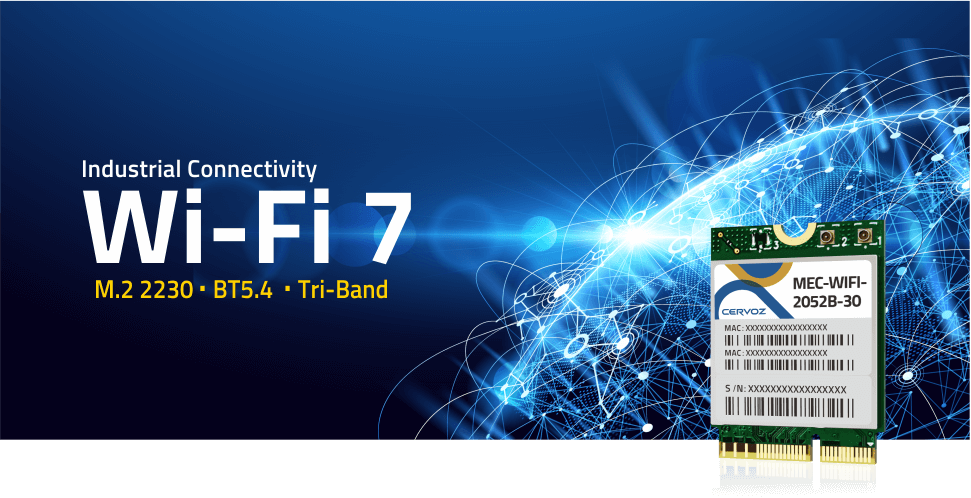
Future-Ready Wi-Fi 7 Module for Industrial Connectivity
In applications such as AGVs, industrial automation involving mobile or hard-to-wire settings, and Edge AI systems deployed across distributed locations, wireless connectivity is no longer optional. It must remain stable, low-latency, and reliable even under high interference.

Whether you are designing a new embedded system or upgrading existing wireless capabilities, are you facing these challenges?
- Platform Compatibility Risks : Many Wi-Fi 7 modules on the market are restricted to specific processor platforms, causing detection failures on legacy architectures and increasing validation risks.
- Spectrum Congestion Nightmares : Across industrial and mission-critical environments, crowded 2.4GHz and 5GHz bands often lead to connection instability and high latency for latency-sensitive and reliability-critical systems.
- Legacy Device Compatibility Trade-offs : The need to support high-speed transmission while maintaining backward compatibility with legacy devices and Bluetooth peripherals.
Four Key Advantages of the Cervoz Wi-Fi 7 Module
-
Broad Compatibility: Say Goodbye to "Platform Picking"
Unlike some modules that enforce strict CPU platform limitations, the Cervoz MEC-WIFI-2052B-30 utilizes the Realtek RTL8922AE-CG chipset. It offers broad hardware compatibility across mainstream industrial motherboards, helping system integrators and industrial users reduce validation effort and inventory complexity.
It also features a standard M.2 2230 E Key interface (Wi-Fi via PCIe Gen2, Bluetooth via USB 2.0), complying with the design specifications of most embedded systems. This allows system platforms to evolve without forcing redesign or immediate replacement of existing.
-
MLO (Multi-Link Operation): Engineered for Low Latency
Multi-Link Operation (MLO) is the most revolutionary feature of Wi-Fi 7, transforming wireless stability. Traditional Wi-Fi operates on a single band, leading to lag when interference occurs. MLO allows devices to transmit and receive data across multiple bands simultaneously. Even if one band (e.g., 2.4GHz) is congested, data can flow seamlessly through 5GHz or 6GHz, providing "wired-like" reliability for medical monitoring and real-time automation. For industrial systems, the value of MLO lies in reducing connection drops and latency spikes, rather than pursuing peak throughput.
-
Unlocking the 6GHz Band: A Dedicated Data Superhighway
The MEC-WIFI-2052B-30 supports tri-band connectivity across 2.4GHz, 5GHz, and the 6GHz band. The 6GHz band offers reduced legacy interference, providing a cleaner spectrum for applications such as Edge AI, and data-intensive wireless workloads. It supports channel bandwidths up to 160MHz with a maximum PHY rate of 2882 Mbps, focusing on stable and usable throughput rather than theoretical peak performance.
-
Integrated Bluetooth 5.4: Future-Proof Peripheral Connection
This highly integrated combo card solution supports Bluetooth v5.4 and maintains backward compatibility with v4.2 and v2.1. Bluetooth dual-mode support allows integration with a wide range of industrial sensors and peripherals, while reducing the need for additional external USB interfaces.
Key Features

- Chipset: Realtek RTL8922AE
- Interface: WLAN:PCIe 2.1 / BT:USB2.0
- Frequency Bands: 2.4GHz / 5GHz / 6GHz (Tri-Band)
- Antenna: 2T2R
- MLO (Multi-Link Operation) Technology
- OS Support: Windows 11, Linux
